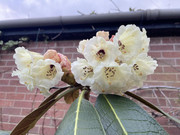
Rhododendron ID
-
MartinNicklin
- Posts: 530
- Joined: Sat Dec 16, 2023 11:50 pm
- Location: Telford Shropshire England
- Contact:
Rhododendron ID
I bought this Rhododendron from Burncoose many years ago. It barely grew in my last garden but I dug it up and brought it with me. It has been planted now for about 9 years but never flowered. I think I put a post on GOTE asking if anyone could ID it from the leaves and there were several suggestions. This year it has flowered which may significantly aid ID. Any ideas? It is one of the large leaf types and one of the big growers.
-
Paul S
- Posts: 912
- Joined: Wed Jan 02, 2019 4:24 pm
- Location: SE Essex
- Contact:
Re: Rhododendron ID
Looks like R. macabeanum to me?
-
Chad
- Posts: 1305
- Joined: Tue Apr 09, 2013 8:48 pm
- Location: Inland Cornwall
- Contact:
Re: Rhododendron ID
Oh Dear,
I will write this very carefully, I don't want to be sued.
I had something similar from a well known Cornish Nursery under the name of R.sinogrande.
It wasn't. After quite a lot of 'work' I concluded it was a 'large leafed hybrid' in the Subsect. Grandia.
I think pure macabeanum has a coloured, bright red in the FCC form, tip to the stigma.
And only 16 stamens, sinogrande has 18 to 20.
To quote from Trees and Shrubs on Line:
Taxonomic note In cultivation the hybrids with R. sinogrande are often difficult to distinguish from this species, but usually can be separated by the floccose leaf indumentum that tends to rub off.
My only problem is that I'm not sure from that statement if it is the pure form or the hybrid that has the floccose leaf indumentum that tends to rub off!
My plant didn't like the exposed situation I garden in and is no longer alive.
In summary, I think you have a 'large leafed hybrid' in the Subsect. Grandia.
Chad
ps. open pollinated seedlings can be produced in large numbers much more easily than cutting derived plants. I'm sure that has no bearing on the plants being sold in Cornwall.
I will write this very carefully, I don't want to be sued.
I had something similar from a well known Cornish Nursery under the name of R.sinogrande.
It wasn't. After quite a lot of 'work' I concluded it was a 'large leafed hybrid' in the Subsect. Grandia.
I think pure macabeanum has a coloured, bright red in the FCC form, tip to the stigma.
And only 16 stamens, sinogrande has 18 to 20.
To quote from Trees and Shrubs on Line:
Taxonomic note In cultivation the hybrids with R. sinogrande are often difficult to distinguish from this species, but usually can be separated by the floccose leaf indumentum that tends to rub off.
My only problem is that I'm not sure from that statement if it is the pure form or the hybrid that has the floccose leaf indumentum that tends to rub off!
My plant didn't like the exposed situation I garden in and is no longer alive.
In summary, I think you have a 'large leafed hybrid' in the Subsect. Grandia.
Chad
ps. open pollinated seedlings can be produced in large numbers much more easily than cutting derived plants. I'm sure that has no bearing on the plants being sold in Cornwall.
-
MartinNicklin
- Posts: 530
- Joined: Sat Dec 16, 2023 11:50 pm
- Location: Telford Shropshire England
- Contact:
Re: Rhododendron ID
Thank you Chad and Paul. I bought sinogrande from Hardy Exotics and it flowered for me but didn’t survive the move. It was bought at the same time as this but this was from Burncoose. Normally I keep the labels but inevitably some go missing. For some reason I also had either macabeanum or sino-falconeri in my head.
I will enjoy it … whatever it is. There’s something special about the tree rhododendrons and whenever I see one in full glory, such as those at Bodnant, something stirs in me, saddo that I am. First flowers ever so hopefully it will be a yearly thing from now on. It was swamped by a monster of a Clematis armandii which encircled the garage, probably 40 ft or more. It was stunning in flower, both appearance and scent, but hidden beneath were this rhodie and two climbing hydrangeas (I won’t name them for fear of upsetting Paul!). At least they will now have a chance to regenerate.
Thanks both.
PS just looked up sinofalconeri. Definitely not that because my plant’s leaves are too narrow.
PPS just looked up macabeanum. Looks more like this in the leaf but don’t know enough, sorry Chad, about the flower’s naughty bits to come to a decision. If you can discount macabeanum on some botanical point Chad, then we will go with your assumption … but that kind of minutiae goes over my peasant gardener’s head.
I will enjoy it … whatever it is. There’s something special about the tree rhododendrons and whenever I see one in full glory, such as those at Bodnant, something stirs in me, saddo that I am. First flowers ever so hopefully it will be a yearly thing from now on. It was swamped by a monster of a Clematis armandii which encircled the garage, probably 40 ft or more. It was stunning in flower, both appearance and scent, but hidden beneath were this rhodie and two climbing hydrangeas (I won’t name them for fear of upsetting Paul!). At least they will now have a chance to regenerate.
Thanks both.
PS just looked up sinofalconeri. Definitely not that because my plant’s leaves are too narrow.
PPS just looked up macabeanum. Looks more like this in the leaf but don’t know enough, sorry Chad, about the flower’s naughty bits to come to a decision. If you can discount macabeanum on some botanical point Chad, then we will go with your assumption … but that kind of minutiae goes over my peasant gardener’s head.
-
s.m.wilkinson
- Posts: 2
- Joined: Sat Apr 18, 2026 8:22 am
- Location: Harrogate, North Yorkshire
- Contact:
Re: Rhododendron ID
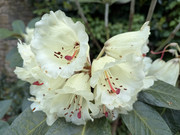
Can I ask if this is compatible with macabeanum? Bought as that but grown from seed - flowering for the first time this year. From previous discussion it seems possible it's a hybrid but seems to fit the description - 16 stamens and red stigma. I'd be interested in views.
Thanks
-
Chad
- Posts: 1305
- Joined: Tue Apr 09, 2013 8:48 pm
- Location: Inland Cornwall
- Contact:
Re: Rhododendron ID
It looks good, especially the 16 stamens bit.
Does it have the floccose leaf indumentum that tends to rub off?
That would clinch it.
There is nothing wrong with growing it from seed if the pollination has been controlled.
Welcome to the board,
Chad
Does it have the floccose leaf indumentum that tends to rub off?
That would clinch it.
There is nothing wrong with growing it from seed if the pollination has been controlled.
Welcome to the board,
Chad
-
MartinNicklin
- Posts: 530
- Joined: Sat Dec 16, 2023 11:50 pm
- Location: Telford Shropshire England
- Contact:
Re: Rhododendron ID
Yes welcome! Chad’s your man for that.
I had a very pleasant day on Saturday looking at the flowering cherry trees on the campus of Keele University. They also had these towering and very lovely rhododendrons but they weren’t labelled as far as I could see. Are they the ones known as Cornish Red?
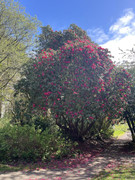
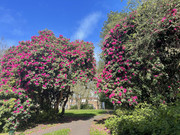
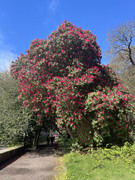
I had a very pleasant day on Saturday looking at the flowering cherry trees on the campus of Keele University. They also had these towering and very lovely rhododendrons but they weren’t labelled as far as I could see. Are they the ones known as Cornish Red?
-
Chad
- Posts: 1305
- Joined: Tue Apr 09, 2013 8:48 pm
- Location: Inland Cornwall
- Contact:
Re: Rhododendron ID
To be honest Martin with those pictures I could only get as far as a 'Red Rhododendron', but the Keele campus is known for its Rhododendrons of the smithii group which includes 'Cornish Red'.
The smithii group is the hybrids between a red R. arboreum and R. ponticum, some of which are known as 'Cornish Red', often with an additional descriptive such as 'early' or ' Leonardslee form'.
I'm not a Rhododendron expert, I only knew the R.macabeanum stuff from having looked it up in detail while trying to sort out what my 'sinogrande' actually was.
Chad
The smithii group is the hybrids between a red R. arboreum and R. ponticum, some of which are known as 'Cornish Red', often with an additional descriptive such as 'early' or ' Leonardslee form'.
I'm not a Rhododendron expert, I only knew the R.macabeanum stuff from having looked it up in detail while trying to sort out what my 'sinogrande' actually was.
Chad
-
s.m.wilkinson
- Posts: 2
- Joined: Sat Apr 18, 2026 8:22 am
- Location: Harrogate, North Yorkshire
- Contact:
Re: Rhododendron ID
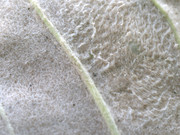
Thanks for the response, Chad
Photo of the indumentum, to the left undisturbed and on the right lightly rubbed. So if my understanding of the terminology is correct it fits the bill.
Very grateful
Mark
-
Chad
- Posts: 1305
- Joined: Tue Apr 09, 2013 8:48 pm
- Location: Inland Cornwall
- Contact:
Re: Rhododendron ID
Excellent demonstrative picture Mark,
Thank you.
Chad
Thank you.
Chad
Who is online
Users browsing this forum: Google [Bot] and 29 guests